

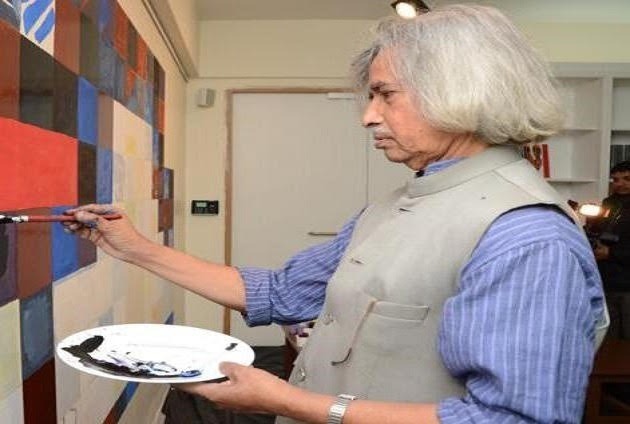
Jogen Chowdhury stands out as a key figure in Indian contemporary figurative art. Across decades he has shown human feelings through twisted shapes, forceful lines and poses that carry meaning and this achievement turned him into an emblem of the art world. His growth as an artist mirrors both his private path and the shifting cultural and political climate of India. From early training to the mature mastery visible today, his output still gives critics, students but also collectors reason to look again.
Early Years and Artistic Foundation
He was born in 1939 in Faridpur, now part of Bangladesh. He spent his childhood amid great social change. The 1947 division of India and the turmoil that followed cut deep into his early life and fixed in him a sharp emotional awareness – that sensitivity later set the stamp on his work. He trained at the Government College of Art & Craft in Kolkata and gained a thorough academic grounding in drawing but also painting.
In those years his pictures stayed close to real structure and to what the eye sees. Early canvases show tight command of the brush, gentle surfaces and a body painted with exact care. The bleak mood that later swallowed work of Jogen Chowdhury still waited in the wings. What meets the eye are traces of Bengal’s old art, the methods of the Renaissance and the strict rules of academic realism.
Transition to Interpreting the Human Body
A decisive shift in Jogen Chowdhury’s work began when he relocated to Paris in 1965. At the École Nationale Supérieure des Beaux-Arts he encountered European modernism, expressionist painting and methods that broke with tradition. In that period he started to challenge the standard way of depicting the human figure. He saw that the body need not be shown only as a set of bones and muscles – it could also bear the weight of inner strain.
When he returned to India, he brought back a new way of seeing. The lines in his pictures grew sharp. The bodies stretched. The faces showed clearer feeling. He no longer tried to show the exact shape of a body – he showed the feeling that lives beneath the skin. Again and again he painted or drew the same signs – deep lines around the eyes, eyes that sink into the head, smiles that look painful, fingers that seem too heavy, torsos that bend like bows. By turning away from outward beauty and turning toward the pain inside, he reached a clear turning point in his art.
The Birth of His Signature Techniques
During the 1970s and 1980s, Jogen Chowdhury began developing what is now called his signature style, which is a unique blend of linework, distortion and dramatic contouring. This phase established him as a master of the human figure in Indian art.
Several defining characteristics emerged:
- Bold black contour lines that wrap around figures like tight boundaries
- Cross-hatching and shading using controlled strokes
- Unnerving human postures filled with tension and vulnerability
- Use of charged symbolism, such as oversized palms or bulging eyes
- Muted yet powerful color palette, often deep reds, ochres, and browns
His works did not flow from one idea to thea next – they held tension and clashed. Lines pressed around the body like bars while shadows pointed to feelings that could not escape. The art from this period spoke of power imbalance, loneliness, fatigue, hypocrisy plus social unease. It forced viewers to face realities they usually ignored.
Themes Inspired by Society and Politics
Jogen Chowdhury has always held that art must show the society it belongs to. A large share of his pictures question social and political arrangements, above all the unfair gaps inside Indian life. The people he paints look hurt, crushed or uneasy – the damage is not to the body but to the feelings.
The everyday problems of people who work for wages, the lack of stability inside families, the control held by politicians and the way moral beliefs change all appear through clear visual symbols. Chowdhury shows the quiet mental strain that lies beneath normal life and he does it without loud drama.
He once said that the body is like a “text of experience”, and his evolution has consistently reinforced that idea.
Later Years: Refining Complexity with Minimalism
In his later works, Chowdhury’s art did not turn louder – it became more refined. He tested minimal backgrounds that left open space so the figure and the line could speak. His paintings turned more poetic yet kept their psychological edge.
We also try out more colors, sometimes just to give a feeling rather than to fill the whole space. People still sit at the center of each picture – yet they look quieter and turned inward, as though they think about what time does instead of resisting it. Oil pastel and ink take over because each lets us stack thin sheets of color and draw heavy edges.
The mature phase shows an artist who has fully mastered his visual vocabulary and now applies it with precision and restraint.
Modern Masterpieces and Cultural Impact
People see Jogen Chowdhury as a ground breaker in modern Indian figurative art. His clear personal style has guided a large number of younger artists who take their cues from the way he shows inner feeling, stretches symbols and keeps the emotion true to life.
Collectors in many countries treat Chowdhury’s pictures as cultural treasures. Major museums university galleries and well-known private collections hold his paintings and drawings. Exhibitions and retrospectives follow his career step by step – they begin with the early academic work and end with the dark, symbol filled images that later made him one of India’s most forceful painters.
Legacy and Timelessness
Jogen Chowdhury’s growth stands out because he never stopped telling stories through human figures. Modern art moved through abstraction, minimalism and digital media – yet he kept the human body as his main means of speech. Every line shadow and distortion shows emotions that strike viewers with force.
His journey shows that an artist grows when he keeps the past and reshapes it into a fresh set of images. Jogen Chowdhury’s best works prove the point – they range from the faithful early pictures to the later fierce emblems.
Conclusion
Jogen Chowdhury changed because he dared, paid close attention to culture and felt deeply. He began with strict academic training and ended with modern pictures known across the world – each step tested what it means to be human. His pictures show that the body itself speaks a story. To see groups of his works and works by other important living artists, go to ArtAliveGallery.
